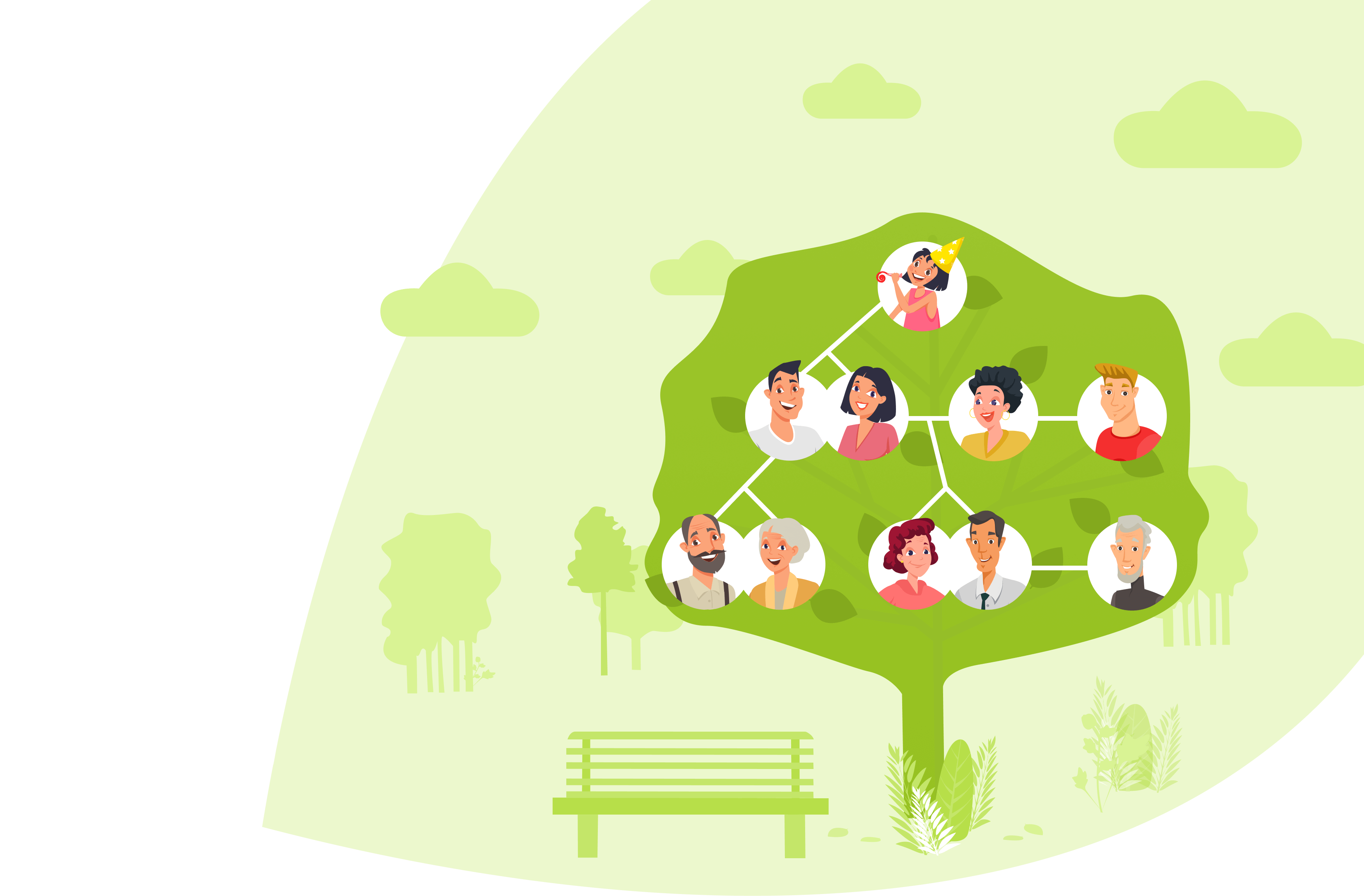
Helping you discover your Hungarian ancestry

About
We were established to help those of you who believe your family is of Hungarian heritage. Particularly, those living outside of the country.
Most people lack the time, resources, and opportunities to carry out their own research. Visiting Hungary or the neighbouring countries, where your family may have originated, is daunting.
Identree was specifically set up to provide support for you. Our English-speaking co-ordinator can liaise between you and the sources of information to provide a seamless service.
Services

Family tree research
We explore your family based on the available data.
Usually, we move backwards from the starting person, so we search for their ancestors. However, researching descendants or two-way research (both ancestors and descendants) is also an option. Based on your preferences, the family tree can also include side branches, i.e. siblings and their descendants.
Family history
We uncover the history of your family.
In addition to the names of the family members, the family tree contains data on their birth, marriage and death, but with deeper research, the family history can be supplemented with additional details. For example, it might be possible to find school certificates, obituaries, legal contracts, wills, name change documents and maps. On request, we also document places, buildings and graves with photographs.
Local history
We can supplement your family tree with local historical data.
In the best scenarios, we can find additional data on your family members, for example, censuses, school notices and contracts. If such documents are not available, it is still possible to learn, for example, how people lived in a given settlement, what their habits were, and what food they ate. Historical events experienced (e.g. resettlement and displacement, wars) also have an important impact on the life of a family. We can also undertake the search and purchase of local history material, like books or articles.
Supplement, check, repair
We can help even if someone else has already started working on your family tree.
Providing another pair of eyes can help locate previously undiscovered data. A thorough review of the information contained in your family tree, which you or another researcher has compiled, can give you the reassurance that the data is accurate, and no wrong conclusions have been drawn. If errors are found, then we can correct these.
Family book & poster
Get your family tree in printed format.
In collaboration with our graphical designer, we can create custom-designed books, charts, family trees, infographics and posters to suit everybody’s needs.
This service is available to anybody, even those who have not used our research service.
Printing will be carried out by a provider close to you, thus reducing costs and the burden on the environment.

FAQ
- What services do you offer?
-
For details, please check services page.
- How is the research conducted?
-
After you ask for a quote, we ask you to provide all available data. From this, we always do a free preliminary search to find out what kind of result you can expect. We may ask you questions. Based on the results, we would jointly define the theoretically achievable goals. We then prepare a price offer, which, if accepted, is recorded in detail in the service contract. The service contract will also include the agreed method of progress update and frequency. We conduct the research as efficiently as possible and share the results with you in the desired format.
What does ‘theoretically achievable goal’ mean? The five generations of a nuclear family tree consist of a maximum of 30 people (plus the starting person). Frequently not every person can be traced. The main reason is that, over time, some registers have been lost, destroyed or damaged. Also even when the register exists, the research in the given branch reaches a dead end due to lack of data. Unfortunately, even with the most thorough preliminary search, this cannot be detected with complete certainty in advance.
It helps if you gather all available information about the family before you contact us. Names of family members, dates and places of important life events, residences, occupations and religious affiliations can help to achieve the goal. If possible, it is worth asking the wider family as well. All data and documents (e.g. birth, death and marriage certificates, other documents, letters, photographs) can be useful.
- What information is needed to start the research?
-
The information required depends on the scope of the research. The most important starting data: names of family members, date and place of important life events, residences, occupations and religious affiliations. In general, the more initial data provided, the more likely the research is to be successful. However, every case is different, and even a small amount of data may be enough, so please, contact us to discuss the details.
- How long does the research take and how much does it cost?
-
The duration of the research is determined by the available data, the purpose of the research and any limiting circumstances. You provide the initial data and we determine the purpose of the research in consultation with you. During the preliminary search, we may detect limitations. We then inform you about the expected date of completion when starting the research.
Every case is different, so we do not have pre-defined packages. To avoid unpleasant surprises, we do a preliminary search and, depending on the results, determine the scope of the research together. We prepare our price offer based on what was discussed. If the price offer is accepted, we record the details in a contract. If a new request arises after the start of the work, we draw up a new contract after consultation. If you have a fixed budget, then this will guide the scope of the research. An additional option would be to conduct the research in stages to spread the cost over a longer period.
We issue an invoice both for individuals and companies.
- What does the effectiveness of research depend on?
-
The result of the research depends on the available starting data and the scope of researchable data. The more accurate the starting data, the better the outcome. Destroyed registers and documents hinder research, and in some cases make it impossible. The GDPR (General Data Protection Regulation) is also an important limiting factor, as many registers cannot be searched for data protection reasons.
In the case of on-site research, we strive to ensure that it is carried out by a researcher with adequate knowledge and experience and who is close to the data source. This reduces the travel time and cost of research and is more environmentally friendly. In the case of online research, we use in-house developed tools to make the research more efficient.
- Do I get a quality guarantee for the work?
-
We guarantee that we act with the greatest possible attention to detail and caution during the research. By following the GPS (Genealogical Proof Standard) guidelines, we ensure the quality. All the results are backed up with tangible evidence. In the unlikely event of an error occurring, we would discuss compensation with you.
- Where do you undertake research and what sources are searched?
-
We conduct research in the territory of Hungary and certain parts of neighbouring countries (Transylvania and Parthium in Romania, Felvidék in Slovakia, Vojvodina in Serbia and Transcarpathia in Ukraine). There is a high probability that the research will take us into one of these areas.
We most often search in church and civil registers, but useful sources include censuses, directories, documents (such as school notices, wills, and contracts), obituaries, newspaper articles, and local history material. Any written or oral source can help with research.
- How can I request a quote?
-
For details, please check contact us page.
- In what format can I receive the result?
-
Protecting the environment is important to us, so by default, we share the results with you in digital format, downloadable from our storage, and protected by a password. If required, we can handle the data in physical format, which can be sent to you by courier.
If you want to receive the results on paper or canvas, we will fulfil your request by using a service provider close to you, thus reducing costs and the burden on the environment.
- I want to learn the basics. Can you help me?
-
Of course. Here you can find some knowledge in different topics:
Family Tree Research in Hungary – Complete Guide to Hungarian Genealogy
Family Tree Research in Hungary – When Beginners Hire a Professional
Hungarian Genealogy Online Records – What You Can (and Can’t) Find Online
Hungarian Genealogy Records Translation – Read Birth, Marriage & Death Records
Hungarian Church Records for Genealogy – Parish Registers Explained
Legal Framework of Family Tree Research in Hungary – What Clients Should Know
Hungarian Ancestors in Slovakia and Romania – Cross-Border Genealogy Research
Hungarian Surname Genealogy – How to Research Hungarian Family Names
Hungarian Genealogy Services Explained – What We Do for Clients
Contact